For the first time in years, Debra Flynn’s hand was still.
“The tremor has stopped,” the Parkinson’s patient told her doctor as electrodes implanted in her brain were activated in mid-November, just weeks after undergoing deep brain stimulation surgery.
“It’s like, ‘Oh my God, my hand’s not shaking!’ That just feels great. It really does,” Flynn said.
Flynn, who has lived with Parkinson’s disease for a decade, said her medications had become less effective over time. By the end of the day, even simple tasks like typing became difficult.
“Towards the end of the day it gets to where I can’t use the keyboard,” she said, demonstrating how her hand would move uncontrollably. “Like it will just slap like that. My hand has a mind of its own.”
Deep brain stimulation offers relief from Parkinson’s symptoms
Facing worsening symptoms, Flynn chose to undergo deep brain stimulation, a complex procedure that required her to remain awake during surgery so she could help guide doctors.
“You’ll be awake, you’ll be recalling and telling us a lot of information,” her doctor told her beforehand.
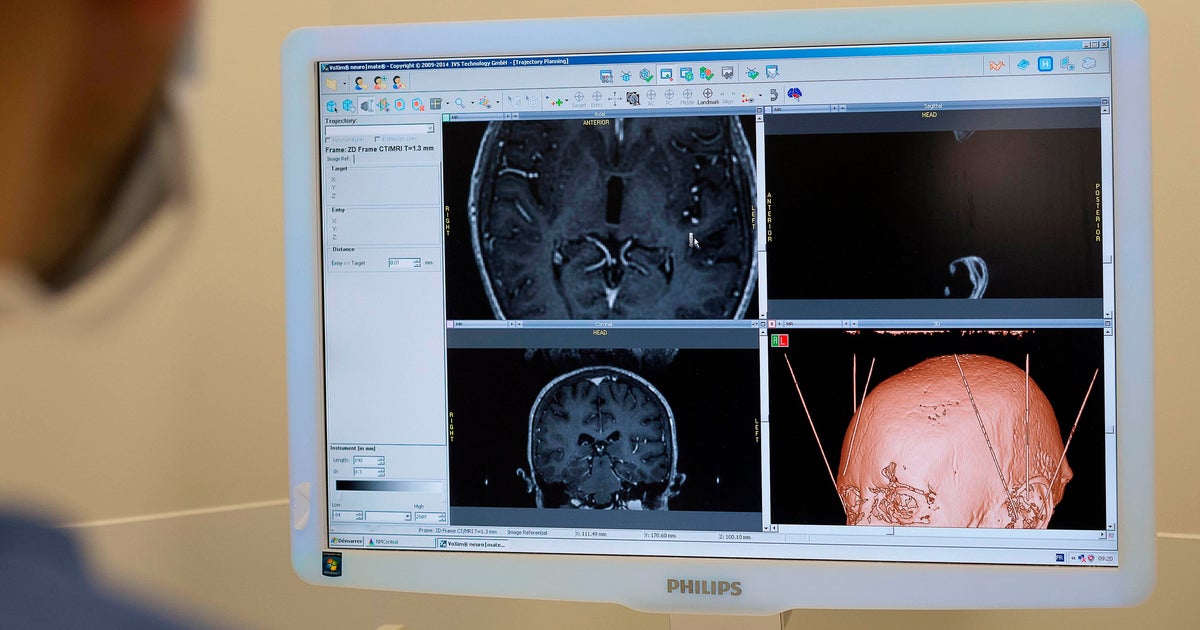
For about three hours, Flynn spoke with her surgical team as they carefully implanted electrodes in her brain, working to pinpoint the exact location that would control her tremors. When they found it, the shaking stopped.
“I feel really good and very excited about the opportunities that will be available to me with this deep brain stimulation,” she said.
While the procedure is not a cure for Parkinson’s, doctors say it can significantly improve quality of life.
“It allows them to decrease medication with at least 50%, and it’s not just that the motor symptoms are getting better, tremors, stiffness and rigidity, but also symptoms like sleep,” said Dr. Cornelio Luca of the University of Miami Miller School of Medicine.
For Flynn and her husband, Jim, the improvement has meant freedom from a strict medication schedule that once dictated their daily lives.
“You know, I spent the first probably five years with this disease feeling guilty, like he didn’t sign up for this,” Flynn said, tearing up. “This will give us the opportunity to have a much better quality of life.”
Life after surgery brings renewed independence and hope
By mid-February, that change was already clear.
“My hands don’t shake anymore. I don’t worry about cutting my fingers off,” Flynn said while preparing food in her kitchen.
Three months after surgery, she says she trusts her hands again, something she hadn’t felt in years.
“I can do things I haven’t been able to do for 10 years, like this, or snap my fingers,” she said. “I haven’t been able to snap my fingers with my right hand since, well, 2015.”
Her tremors have largely disappeared, along with dyskinesia, the involuntary movements caused by long-term medication use. Some rigidity remains, and when the stimulation is turned off, the tremor returns within seconds.
“Look what’s happening,” she said as the shaking came back.
Flynn still struggles with insomnia, and she knows the disease will continue to progress. But her daily medication has dropped from seven pills to one, and the improvement has given her renewed hope.
“The disease is gonna continue to progress, but if I can get, you know, four, five, six years out of it like this, boy, it’s worth every minute I spent having it done,” she said.