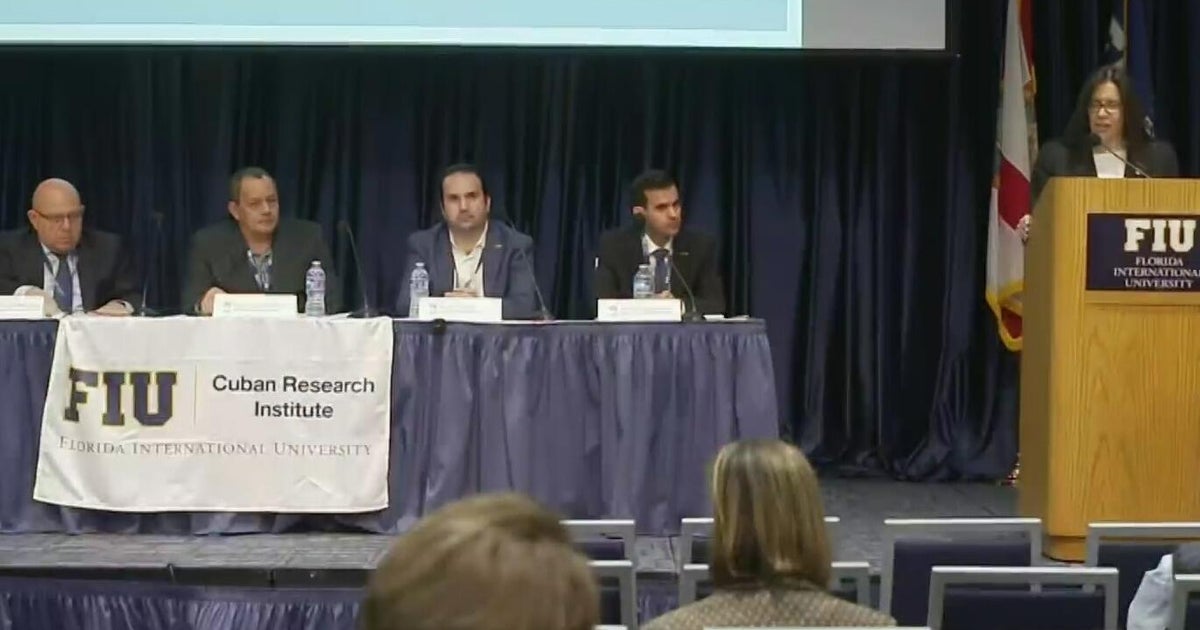
Florida International University’s Cuban Research Institute is hosting ‘Cuba: The Day After Tomorrow’ at an incredibly relevant time. While the conference is meant to focus on the island’s future, developments from the past 24 hours are dominating the conversation.
“The main thing is it’s a tragedy at a very difficult time in Cuba-U.S. relations,” said longtime Cuba demographer Sergio Diaz-Briquets. He is suspicious of the timing.
“Everyone I speak to is saying exactly that. Why now?” questioned Bisquets.
He went on to say the facts will matter, but worries Havana could seize on the incident to accuse the U.S. or U.S.-based groups of aggression, furthering a long-standing narrative.
Attorney Jason Polete says after watching Cuban state media, he believes the government will use this as a distraction.
“They are trying to capitalize on it. To distract from whatever is happening right now, which is a humanitarian emergency,” said Polete.
Beyond the confrontation at sea, Cuba is still grappling with a worsening economic crisis.
While Washington is now allowing limited oil access from Venezuela to the island’s private sector, many experts at the conference say it’s simply not enough to address the scale of the problem.
“A tanker carries hundreds of thousands of barrels. That’s what they need. Cuba needs over 100,000 barrels every day,” said Sebastian Arcos, interim director of the Cuban Research Institute.
Arcos says he’s convinced the limited amount of fuel allowed under the new licenses would ultimately benefit the regime.
“It’s a private sector that was fabricated by the Cuban government, precisely taking these loopholes allowed by the U.S. embargo,” said Arcos.
“So who’s benefiting, the population? No. This is not going to public transport or the generation of electricity,” he added.
Many at the conference agree Cuba’s crisis was already deepening long before the capture of Venezuela’s Nicolas Maduro. But with new oil restrictions imposed by President Trump, the current situation on the ground is not just unprecedented, it’s unsustainable.
“Because no modern economy can function without fuel,” said Arcos.