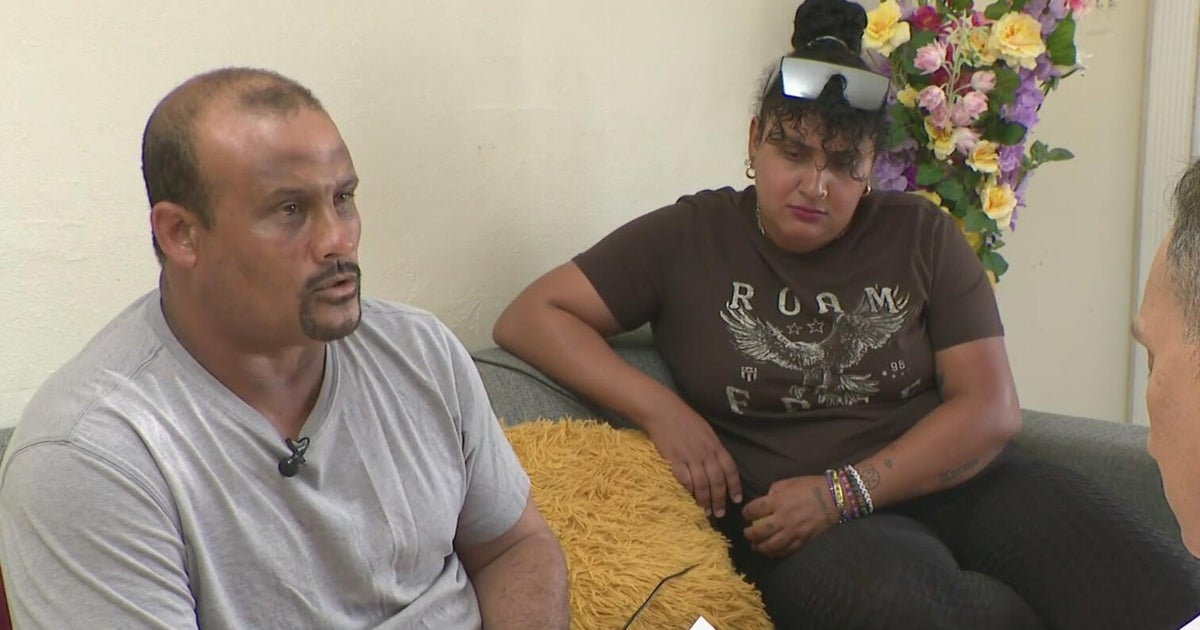
A South Florida man from Cuba who was recently released from the immigration detention center known as Alligator Alcatraz is now being told to self-deport in a case that an immigration attorney said could become more common in the months ahead.
For Maikel Rojas and his family – the clock is already ticking.
Rojas, a 45-year-old immigrant from Cuba living in South Florida, said federal immigration authorities recently handed him documents ordering him to prepare to leave the United States no later than August 4, 2026.
His wife, Roxi Torres, fears immigration agents could return to detain him at any moment.
“In case the officers come here and my husband goes to immigration or something happens,” Torres said through tears.
Rojas told to obtain passport, purchase one-way airline ticket
Rojas showed CBS News Miami documents titled “Plan of Action for Removal,” which instruct him to obtain a passport and purchase a one-way airline ticket.
“I should leave no later than August 4 of 2026,” Rojas said in Spanish.
The situation has left him confused. Just last month, he says, immigration officials at the Miramar Immigration Center instructed him to report back in May of next year.
Now, he has been told to prepare for deportation.
Rojas does not currently have a passport. Because he was born in Cuba, he would need a Cuban passport to travel there.
Immigration attorney Willie Allen, who is not representing Rojas but has practiced immigration law in South Florida for more than four decades, says the case reflects the limits facing immigrants with serious criminal convictions.
“In truth, his opportunity to live here has run out,” Allen said.
Allen explained that under federal immigration law, immigrants convicted of certain crimes after 1996 – particularly offenses carrying sentences longer than one year – can be permanently barred from remaining in the United States.
“Anybody who committed a crime after 1996, and that crime had more than a one-year sentence is barred from living in the United States,” Allen said.
Rojas was arrested the year after arriving in the U.S. from Cuba in 2004
Rojas arrived from Cuba in 2004. The following year, he was arrested and later convicted as an accessory to murder. He served 13 years in prison.
After his release, Rojas was required to check in annually with immigration authorities. That changed last October when he was detained by U.S. Immigration and Customs Enforcement (ICE) and sent to Alligator Alcatraz, where he remained for nearly five months.
In March, ICE released him with an ankle monitor. More recently, the Intensive Supervision Appearance Program (ISAP) – an alternative to detention program that works with ICE – provided him with the documents instructing him to self-deport.
Torres says the possibility of losing her husband again is devastating for the family, which includes a 15-month-old child.
“It’s a very bad experience because when you have a child and you have a life in the United States,” she said before breaking down in tears. “Everybody has an opportunity to change.”
Rojas fears Cuban authorities will not accept him
Rojas says he was previously told he would likely be deported to Cuba, though Cuban authorities might not accept him.
“I was told I was going to be deported to Cuba but that government may not accept me,” Rojas said.
According to ICE, as of late March 2026, the Trump administration had returned 1,901 Cuban immigrants to Cuba since January 2025, including individuals with criminal records.
Allen says immigrants who receive removal instructions while wearing ankle monitors should take the situation seriously.
“My advice would be, the chances you stay here for a long time, short time are limited,” Allen said. “Take this opportunity to find a country you can immigrate to, see where you can make your best life and do it.”
The attorney warned that immigrants who ignore removal documents risk being detained again by ICE – and this time, authorities could determine where they are sent.