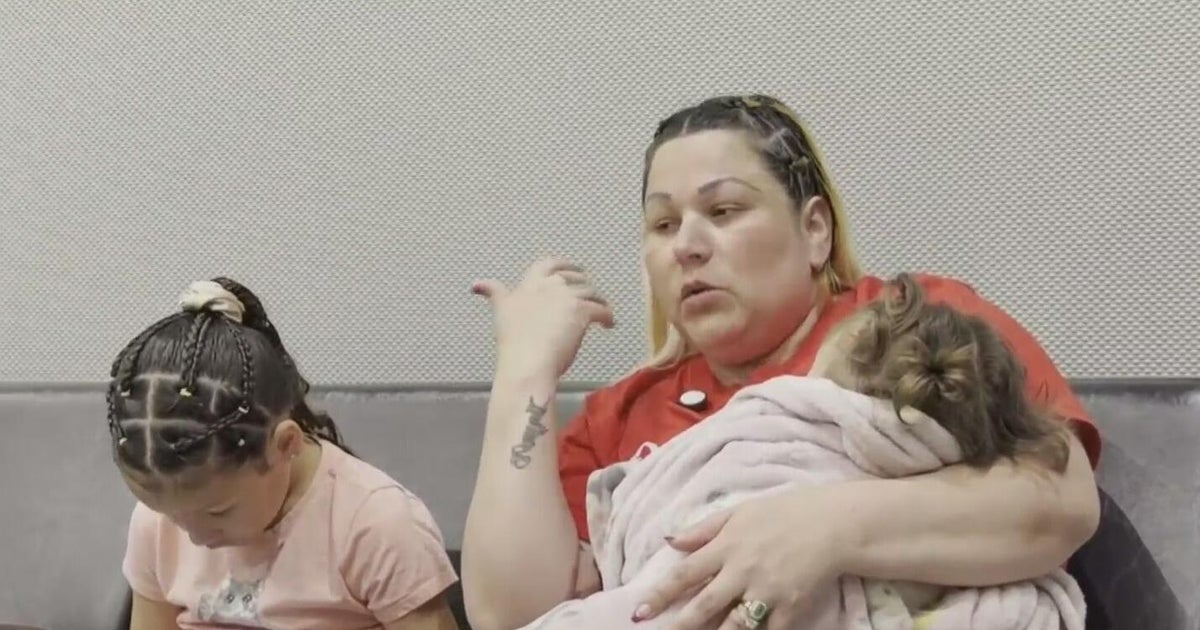
A Venezuelan mother and her two young daughters who spent weeks trying to leave the United States on their own terms are now back in Venezuela, ending a difficult and uncertain journey.
Yelitza Perez, 29 had been trying for weeks to return home voluntarily, avoiding a formal deportation by immigration authorities. She explored multiple options, including registering with the federal government through the CBP Home app — a tool designed to allow migrants to notify officials of their intent to self-deport.
CBS News Miami
But she says she never received a concrete response.
Instead, the biggest obstacle turned out to be paperwork.
Last month, Perez made it all the way to the airline counter at Miami International Airport, only to be denied boarding. Airline staff told her she could not travel without a document issued by the Venezuelan government — something she did not have at the time.
CBS 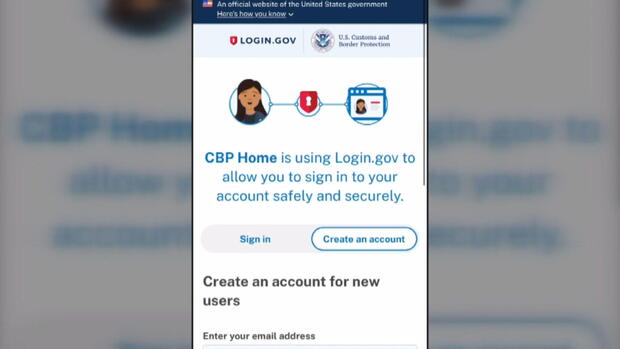
Determined not to miss another opportunity, Perez and her daughters returned to the airport this past weekend, this time spending the night there to make sure nothing would go wrong.
“Gracias a Dios… llegó el documento,” Perez said in Spanish, expressing relief after finally receiving what is known as a “safe pass,” a travel document issued by Venezuela for citizens without a valid passport. She says her husband, who was deported from the U.S. earlier this year, helped her obtain it.
Carrying her one-year-old daughter Ixchel, Perez boarded the plane that would take them back to Venezuela.
“I wasn’t the only one… there are many Venezuelans in limbo,” she said.
Perez is one of the many migrants that turned over their passport to U.S. authorities when entering the country through the southern border — a common practice that can complicate efforts to leave voluntarily.
For her nine-year-old daughter, Paola, the return home brings mixed emotions.
“I’m happy because I’m going to see my family. I really miss them,” Paola said.
But she added she will miss her life in the United States.
“My friends and my teachers… I’ve been with them for four years,” she said. Paola was five years old when she arrived in the U.S.
CBS News Miami first met the family in March, when Perez had already taken steps to self-deport by registering through the CBP Home app. The platform is part of a broader effort by the U.S. Department of Homeland Security to encourage voluntary departures, in some cases offering financial incentives.
However, Perez said she never heard back after submitting her request.
Government figures on how many migrants have self-deported vary widely.
The Department of Homeland Security has publicly claimed that between 1.9 million and 2.2 million undocumented immigrants have voluntarily left the country as of early 2026, some incentivized by stipends of up to $3,000 per person.
But a CBS News analysis of data from the Executive Office for Immigration Review found a significantly lower figure — about 72,000 people between January 2025 and February 2026. Approximately 71% of those individuals were already in Immigration and Customs Enforcement custody at the time of their departure.
Immigration attorney Willie Allen says many of the cases tied to the CBP Home app involve limited follow-through.
“Out of those, about 37,000 have received compensation,” Allen said. “I’ve had several clients leave through the app, but only one actually received a payment.”
For Perez, the statistics were secondary to the outcome.
After weeks of uncertainty, she shared a video with CBS News Miami showing the moment she boarded the plane — expressing gratitude that her journey was finally over.
CBS News Miami reached out to the Department of Homeland Security for information about Perez’s case. In a brief response, the agency said it had received the inquiry and would need more time to provide details.