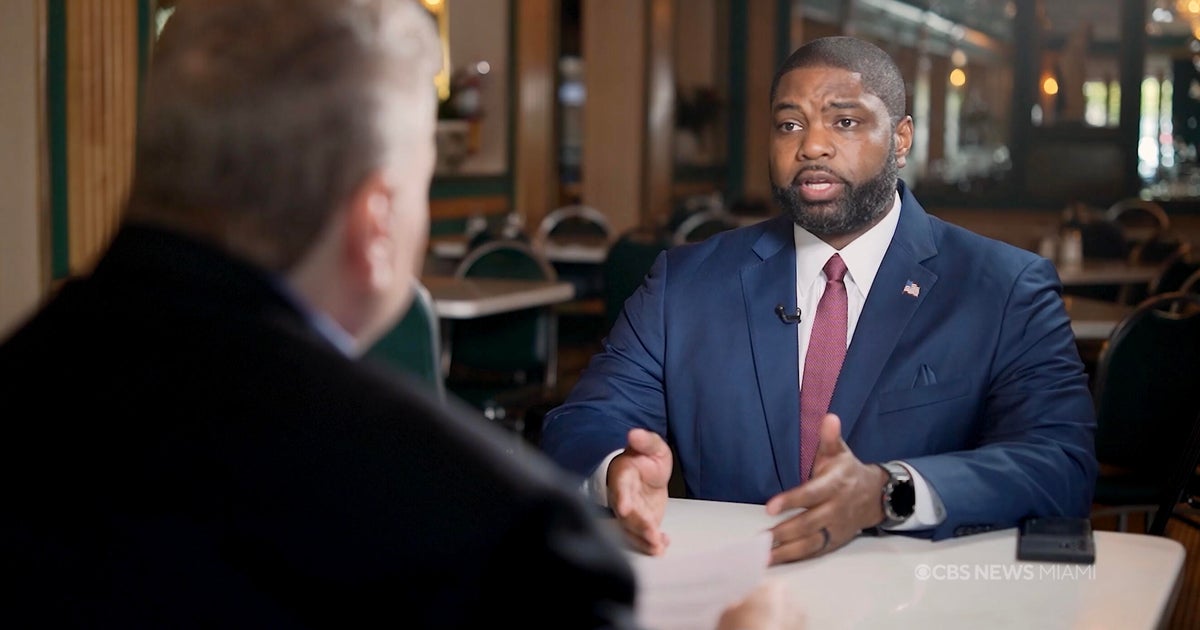
On Monday, March 2, 2026, CBS News Miami sat down with Republican Congressman Byron Donalds, the leading Republican candidate for governor in Florida, to discuss a wide range of issues, including the early years of his life, being raised by a single mother, and his arrest on marijuana charges where he acknowledged for the first time that as a teenager he actually sold drugs. Donalds spoke about how his arrest caused him to change his life and he addresses criticism that he was being hypocritical for sponsoring a crime bill in Congress that would deny young adults the same mercy and grace he received from the courts in Florida after he was arrested.
The interview also covers his thoughts on possibly being the first black, Republican governor of a Southern state, his strained relationship to Governor Ron DeSantis, and his thoughts on a variety of issues including eliminating homesteaded property taxes, Everglades restoration, and his support for AI data centers as well as his position that private companies should be allowed to build small nuclear reactors to power those centers.
The following is a complete transcript of that conversation.
Jim DeFede:
Alright, let’s turn to you running for governor and let’s talk about those issues. There’s a lot I want to cover in this interview in terms of some of the policy issues, but I want start by talking about your background, because it’s a very interesting background that I’m not sure a lot of people in South Florida necessarily understand. I’m sure they know it in your home district, but a little less so here. First off, we’re both from Brooklyn. I grew up in Bay Ridge, you grew up at Crown Heights, to a single mom with you and two other kids. Talk to me about what those early days were like for you and what you remember, and basically the beginning of your life and what your story is.
Byron Donalds:
Well, I mean, look, I wouldn’t be here without my mother. My mother did so much for me. She sacrificed a lot to help me get the best education I could. My mom was a school choice mom before school choice was a thing. She moved me out of public school very early, and it made a ton of sacrifices to put me in private school so I could get the education possible. She was a tough lady. She’s tough, she was strict, she did the very best job she could do for me and for my sisters. And so I wouldn’t be in the position I am today without my mother. Leaving New York was a decision, as a young kid, was basically like, I’m going to go somewhere else, I’m going to go far away. I kind of looked at Florida, looked at a couple other states that I figured I was going to go to get my college education. But I can’t stress enough, growing up in New York was hard. Hard upbring but my mother did everything she could.
Jim DeFede:
But when you say it was hard, what was hard about it?
Byron Donalds:
Well, we grew up poor, number one, in my neighborhood in Crown Heights, Brooklyn at the time. That was during the crack epidemic. I remember sometimes I was going to baseball practice in the morning and you would be walking down the street to go to the train station. You see crack vials all over the street corners in the early mornings before people would come out and clean them up from the night before. My mayors in New York were Ed Koch, David Dinkins, and Rudy Giuliani. So I remember when Rudy took over because the streets became so much safer because Rudy made sure their officers were on the streets every single day, as opposed to what was happening in previous administrations, where the cops were basically in their precincts and not actually walking the beat and holding low-level crime accountable.
Jim DeFede:
Can I ask you what happened to your father?
Byron Donalds:
My parents just never married, you know, they just the… things just didn’t work out. That’s life.
Jim DeFede:
Do you have a relationship with him at all?
Byron Donalds:
We do have a relationship. We talk periodically, but I just didn’t grow up with my dad.
Jim DeFede:
Obviously, when you came to Florida as a young man, you did have some troubles with the law yourself.
Byron Donalds:
Yeah.
Jim DeFede:
You were arrested, I think when you were 18, on a marijuana charge. What can you tell me about that?
Byron Donalds:
Stupid decision. Honestly, I was walking down the street. Officers, I was leaving a party, officers came up, asked me if I would empty my pockets. I said, yes, of course. I had a dime bag of marijuana in my pocket. That’s the story. And so, you know, it’s tough because there’s a lot of decisions that I wish I could go back and redo from those early years. Like 18, 19, and 20 were really tough years for me. Made a lot of bad decisions that I regret. But in life, you don’t just, you’re not who you are at the lowest point in your life. What you do is you decide to just push forward and try to make sure you make better decisions in the future. And I would tell people, if you examine my life since 20 years old, my life has really been a story of redemption.
Jim DeFede:
I want to talk about that redemption arc, but before I get there, I just want to be clear on a couple of things with regard to your arrest.
Byron Donalds:
Sure.
Jim DeFede:
The charge itself that was listed in court documents was possession with intent to distribute. Your ex-wife or your first wife at the time gave an interview recently in which she said we had this neighbor who sold drugs and they, meaning you and the neighbor, got close. Byron thought that that was his path to fix his money situation. He was making bad choices. It was never a sense of why he did it. I had a level of concern, I had to worry, what if he got arrested? Your ex-wife says that you were actually not just possessing drugs, but you were selling small amounts of drugs.
Byron Donalds:
Yeah, it was bad decisions.
Jim DeFede:
So you were…
Byron Donalds:
I can’t undo that decision.
Jim DeFede:
So you were selling?
Byron Donalds:
Ah, yeah, for a period of time, low level amounts. Terrible decisions. Jim, like I told you, those years of my life, there are a lot of things I wish I could undo. I wish could, but I can’t do that. You know, I was a youth leader for 12 years in my community in Southwest Florida. And what we always told the young kids is that when you mess up, you make up, but you never give up. And I messed up early on. It’s one of the reasons why I spent so much of my other years in Southwest, Florida mentoring young kids serving in my church helping them make sure they don’t make the decisions that I made when I was 18.
Jim DeFede:
And you had another incident with a fraud charge that related to a bank debit card.
Byron Donalds:
Yes.
Jim DeFede:
And again, it was something that happened when I think you were 20. When you were 18, the case ended up going through a diversion program. You stayed good for a year. I think if you paid a fine, the charges were ultimately dropped. With the fraud charge, I think it’s not clear because the records were sealed and then expunged.
Byron Donalds:
Right.
Jim DeFede:
In both those cases, it seemed that you received some mercy from the courts, either through a pre-trial diversion program or by recognizing that you were a youthful offender, having your record sealed and eventually expunged. There has been some concern raised that, for instance, you’re the sponsor of the DC Crimes Bill, which would overhaul some of the criminal justice for youthful offenders in the District of Columbia area, and there are those who believe that the stance you’re taking now is hypocritical given that some of the very grace that you were shown in cases in Florida, you would deny to people in similar situations in the District of Columbia.
Byron Donalds:
Well, listen, first, let me talk to the D.C. Crimes Act. I’m a proud sponsor of it. The problem in the District of Columbia is that they were treating 24-year-olds as if they were juveniles. And look, I will never say that the decisions I made when I was very young were right decisions or smart decisions. They were terrible decisions, desperate decisions. But in Florida, I had to face the music as an adult. In D. C., they were letting 24- year-olds be tried as juveniles, that’s not right, Jim. It’s one of the reasons why juvenile crime in D.C. is shooting through the roof. So let me be clear with you on this one. So what we did in D.C. is we said, if you’re 24 years old, if you are 20 years old. If you’re 19 years old you’re going to be tried as an adult in the D. C. juvenile, in the DC system, not as a child.
Jim DeFede:
Except I’m not sure your description of what the impact of the law is accurate. From what I understand, it doesn’t necessarily mean that 18- to 24-year-olds will be tried as juveniles. It would allow people in that range in certain cases to have their convictions sealed and receive more flexible sentencing options at a judge’s discretion.
Byron Donalds:
I’m just telling you that’s not true. What we did in a DC crimes act is we made sure that people who were of that age, people who are the age of maturity the age, of adulthood.
Jim DeFede:
The age that you were.
Byron Donalds:
Exactly.
Jim DeFede:
The age that you were.
Byron Donalds:
And in Florida, I had to face the music as an adult, not as a juvenile. Now Florida does have laws around diversion, being able to seal records, and yes, those are things that were afforded to me. And I look back on those days and I say, you know what, that helped me restart my life, so be it. But in DC, it was very different. In DC, they were trying 23-year-olds as juveniles, Jim, and you can’t do that because what ends up happening…
Jim DeFede:
Not all 23-year-olds were being tried as juveniles.
Byron Donalds:
But enough of them were. And that’s what was happening in Washington, D.C. That’s why I authored the D. C. Crimes Act, because the truth of the matter is you gotta have a standard when it comes to criminal justice. And if you have that standard and you back law enforcement with that standard, that’s how you have safe streets and safe communities. I wouldn’t argue today, and neither would you, that the Florida system of law, which has been in place since I moved to this state 30 years ago, has allowed for juvenile crime to run rampant. But in Washington D.C., it is running rampant. And furthermore, not just with juvenile crime, with people between the ages of 18 and 25 years old, it’s running rampant. That’s why we authored the D.C. Crimes Bill, passed out of committee in the Oversight Committee, passed on the floor of the House of Representatives in Washington, D. C. And I would argue my critics who want to talk about that bill and want to have this false claim of hypocrisy, they say that because they want soft-on-crime policies in D. C. They do not like the fact that President Trump has actually put in the policies that has made the nation’s capital safe once again.
Jim DeFede:
I want you to talk for a second about, you know, when you faced, because I want to talk about your redemption arc, because when you, when faced that time when you were 18, 19, 20 years old, it almost seems that the first two decades of your life are very different from the second two decades. So I want your to sort of say, what do you think was the critical moment in that? And I know that from looking at some interviews, you talk about meeting and the influence that your current wife, Erika, has on you. Talk to me about why, how that change came about.
Byron Donalds:
Well, look at 20, I was at a real depth in my life. I was a the bottom. And I remember very clearly, I was sitting in the room one day looking up and I said, I don’t know how I got here, but I’m going to make sure that I’m never here again. And so, after that point, every decision I made was about being a better man than I was before. It was about a father to the kids that I knew I would have in the future and being a quality husband to my wife and a leader in my community. All things that have occurred. At 21, I gave my life to Christ. It’s a story out there, I’ve talked about it before. I actually gave my my life to Christ at a Cracker Barrel when I was at work. But before giving my life to Christ, the person who got me going to church was my wife now, my girlfriend at the time, Erika Lees, now Erika Donalds. And so the redemption story first was acknowledging that I was making a lot of terrible decisions as a young man, as a young kid, and that I had to do better for myself. The second was acknowledging that God is there for us every step of the way if you trust them. And so I started going to church and the rest is history.
Jim DeFede:
I don’t want to make too much of this, but it’s a fact. You would be the first black Republican governor of a Southern state.
Byron Donalds:
Yes.
Jim DeFede:
Where does race come, where does that notion that you would be the first Black Republican of a southern state, does that enter into your thinking at all? Do you think, I mean, obviously you’ve lived your entire life as being black. So, you know…
Byron Donalds:
Yeah, it’s a thing, it’s a thing.
Jim DeFede:
…I get that answer, but do you recognize that this would be significant?
Byron Donalds:
I’m aware of it, but I don’t really focus on it. Actually, in this entire time in politics, I’m not really focused on race as a marker. You know, in Florida, southwest Florida in particular, but Florida overall, we’re a meritocracy. We’re one of the great meritocracies in not just America, but in the world. And so I think it’s not so much about my race. I think is more about the policies I support, the principles I stand for, common sense conservative policies that have made Florida the envy of the other 49 states in the union.
Jim DeFede:
Do you think that you had an advantage of moving up in the Republican party because you’re black, because that you’re someone who the Republican Party would want to champion to show their diversity?
Byron Donalds:
And I’ll tell you actually, this race has been a little different for governor, but in any of the other campaigns I’ve been a part of, I was always the underdog. That’s why this one’s a little bit different. I was the underdog. Never really the choice of donors, never really the choice of a lot of the traditional segments of the Republican party. I came up through the Tea Party movement, I was a Tea Party activist, a frontline conservative, so the Tea party movement was my first strong political base still is to this day, and I think what really happened, whether it was my race for state house or a race for Congress, it was that people would hear me talk about the issues of the day, my focus on conservative principles and not just the principles today, but also the philosophy of why conservatism is the policy set that has freed so many people from bondage. It’s the things that has led to economic liberty, economic growth for so many Floridians, so many Americans and people who choose to make America their home legally and why it’s the best principle set for the future of our country.
Jim DeFede:
I’m not going to ask you if you’ve experienced incidents of racism because I think that’d be a dumb question. I’m more curious as to how you deal with incidents of racism and are there any that stand out since you’ve been, you know, as an adult here in Florida?
Byron Donalds:
Yeah, there’s a couple that stand out, but but let me be very clear the vast majority of our people respect people based upon who they are, how hard they work what they stand for and do they have alignment with those values and those beliefs. And at that point people don’t really care about your color They just want to know if I do I agree with you, but you are you going to stand for the things that I stand for.
Jim DeFede:
But is there an incident that sticks in your mind that will always be in your mind?
Byron Donalds:
I mean, yes. I was getting petition signed, but I was running for a state representative. And I remember I was at a local fair and I walked up to two gentlemen and I said, hey, would you sign a petition for me? And one of the gentlemen just looked at the petition and wouldn’t even look me in the eye. The other one glanced at me and looked off and said, No, I’m not interested in doing any of that. And at that point, I could pretty much tell, like, okay. This isn’t about being a Republican. This isn’t about anything else. But I would also tell you, Jim, that that is one thing that just remained in my mind. But as I crisscross the state today, I’ve been in 54 of the 67 counties already. The people of Florida are awesome. I was in Suwannee County two nights ago. I was at Monroe County yesterday. I’m here in Miami today. People of Florida, what they want to make sure is that Florida remains on the trajectory it’s going. They love the free state of Florida.
Jim DeFede:
And last question about this, only because your wife is white, have you experienced any backlash as a result of that, marrying a white woman, or has your wife experienced any of it from marrying an African American?
Byron Donalds:
No, I think people, especially in today’s America, people just want to make sure that you’re just going to be a good family, good husband and raise good kids.
Jim DeFede:
You know, there are some in the black community who will make criticize you for marrying a white woman. Have you dealt with that?
Byron Donalds:
I mean, they don’t criticize Kamala Harris.
Jim DeFede:
All right, I’m going to get to issues, but you’re running to replace Ron DeSantis. I’m fascinated by the dynamic between you and the current governor. It seemed like for a long time you and he were strong allies, and then something happened. And I think it basically comes down to you endorsing President Trump and not him when he was running for the White House. How would you describe your relationship to Ron De Santis?
Byron Donalds:
It’s been better, but I think it’s something where you know you can find ways to come back together and work a work You know work about how what we’re going to do for the future of our state.
Jim DeFede:
What do you think his biggest mistake has been as governor?
Byron Donalds:
He’s actually done a great job, to be honest with you, Jim. I think he’s done a good job, and I think being in leadership is tough when you’re the person that has to make the decisions is hard, and it’s really about just making sure I think you get as much information and input as you can, but you can’t really second-guess somebody who’s been in that position because you’ve not been in that position.
Jim DeFede:
Does it bother you that so many of his senior advisors, or several of his senior aides have been, were found to have actually be giving advice to and helping your opponent, James Fishback, someone who has been using a virulent and basically a racist attack against you, and yet there are the governor’s aides who have been seen helping him and who they admit were helping him for a time.
Byron Donalds:
One thing people need to understand is that the internal politics inside of political parties is probably far more vicious than the things that happen between Republicans and Democrats and independents. Look, when you get into this business, you better have Kevlar skin. Not thick skin, Kev-lar skin, and so I think that’s something where if the governor chooses to deal with that, he will with his people and his team. We stay focused on just campaigning, working hard, earning the votes of the people of Florida, because at the end of the day, that’s what matters.
Jim DeFede:
What do you think of James Fishback’s attacks on you?
Byron Donalds:
Honestly, I just think it’s somebody trying to get more attention than anything else. So I really don’t pay much attention to him. I don’t much pay attention to anybody else who’s running. How I’ve always done my campaigns, Jim, is I stay focused on what I’m doing. I go meet the people that I’m asking for their vote for. We talk about the issues that are important to them. You can’t get caught up in the distractions. You can get caught in what other campaigns are doing. Half the time, other campaigns just want to get you distracted. So you lose focus on what you’re doing. And I would argue. If people are looking at polling, looking at other metrics of campaigns, I think the strategy of just ignoring the noise and ignoring other people who just want attention has actually worked out to my benefit.
Jim DeFede:
So let’s talk about some of those issues. What do you think is the number one issue facing Floridians?
Byron Donalds:
Well, there’s two big ones. The number one doesn’t really show up in polling, and that’s where the people of Florida want our state to remain on the trajectory that it’s been going. Governor DeSantis has done a tremendous job leading our state, and so our voters are saying, we like where it’s going, can we keep it going in that direction? They have my 100% commitment. The same policies, the same common sense conservatism that Governor Desantis brings to the job is something I bring to the job, and here’s why. I’m a member of the House Freedom Caucus in Washington, similar to Governor DeSantis. If you look at my voting record, I have one of the most conservative voting records in America, not just at the federal level, but also at the state level. And so when you take, when that’s your baseline philosophy, I think that’s an indicator of that Florida’s going to continue in the same common sense conservative way. But the other big issue obviously is affordability. We have young people who are trying to figure out how they’re going to afford a home of their own. We have seniors on fixed income trying to figure out how they are going to deal with insurance. And so what we’re going to look at is tackling insurance, making sure that we continue to lower property, property insurance rates in our state, working off of the reforms that Governor DeSantis put into place a couple of years ago. And then obviously with property taxes, we’ll see what the governor and the legislature get to. Well, I want to get…
Jim DeFede:
Well, and I want to get to that, but I just want to use the word affordability. I seem to remember the president saying that affordability was a hoax and that affordability wasn’t really an issue, that he had beaten and won affordability, but you still acknowledge that affordability is an issue for people in Florida.
Byron Donalds:
Affordability has been an issue across the country, but let’s be clear about what President Trump was saying. What President Trump was seeing is that the Democrats caring about affordability is a hoax because Democrat policy created this, Jim. I was in the Budget Committee when Joe Biden was bringing his plans for budget reconciliation, and you could clearly read their bills and know what was going to happen is you were going to create a labor shortage in the United States that was going lead to significantly higher prices. That’s exactly what happened. You had Larry Summers, who was President Obama’s chief economist at the time, was saying that this is policy that’s not needed. It was going to create inflation in the United States. So what President Trump is talking about is that Democrats all of a sudden who care about affordability are lying to the American people. That’s like the arsonist trying to be the firefighter. It just doesn’t work.
Jim DeFede:
I want to go back to property taxes. You sort of said a second ago that you’ll see what comes out of the legislature. You’re going to inherit this. Whatever the legislature decides and voters approve in November is going to be affecting how you run the next four years if you’re elected governor. Do you have a plan for what you would like to see done on property taxes?
Byron Donalds:
Well, I agree with the governor that we need to repeal Homestead property taxes. Property taxes in our state, especially for Floridians, has doubled in the last decade. In the last five years, local government budgets have grown massively out of control. The Dogeing efforts that the CFO and the governor are doing right now are critical for the future of our state. We’re going to continue those Dogeing effort and it’s going to be for every form of government in the state of Florida, including the state Florida and state agencies. Everybody has to be examined. Everybody’s got to tighten their belts. Because the people in our state, those who are working hard every single day, our seniors who are trying to find ways to keep their Florida dream alive, and our young people who are trying to get into the Florida dream, they don’t have the cash. So we have to do this. And then the key thing is, how do you cut these budgets while making sure that sheriffs still get paid, that deputies still get paid, that firefighters still get paid, you take care of roads, you take of land management issues. That’s the balance that we’re going to have to strike.
Jim DeFede:
I just want to be clear because when you make a statement like you want to end property to all homesteaded property taxes. Does that include the property homested of property taxes that go to school districts?
Byron Donalds:
Yes and let me talk about school districts now. The biggest people who’ve actually increased property taxes on the hardworking men and women of our state are school districts. But let’s also acknowledge the reality, Jim. Miami-Dade public schools, their populations are decreasing. Same in Broward County, same in Hillsborough County, same in Collier County where I live, Lee County, Florida, et cetera. And the reason why their populations are decreasing is because of universal school choice. Which the legislature finally passed a couple years ago, which is something I fully support. I’ve been a school choice champion and advocate my entire time in politics. That’s not going to change. But the fiscal reality is, is that the school districts have less students today than they did when we passed universal school choice. Yet at the same time, their budgets have expanded because they’re collecting far more property taxes than they ever have.
Jim DeFede:
I want to drill down on this a little bit more just because you you made a statement talking about the CFO and the governor’s doge Efforts part of what has never been really understood during that is that the state, Tallahassee has a real habit of transferring burdens onto local governments cities and counties and telling them, okay now you pay for this. That’s one of the reasons why those state budgets or why those county and city budgets municipal budgets have gone up. There’s also was no analysis that the Doge folks did in Florida as to where that money was spent or how it was being spent, rather than I was being sent to provide new services. I’m just curious, it sounds great to tell people we want to do away with your property taxes and we’re not going to affect sheriffs or police officers. I don’t know how you can do that without affecting a lot of services, including police and fire, but how do you pay for roads? How do you play for parks, libraries, aren’t all those issues that are important for people.
Byron Donalds:
They are all important and they’re all critical, but let’s talk about DOGE first and I’ll come to the key services you’re talking about. When it comes to DOGE, they are starting this process of examining all these budgets. I’m aware of the Governor and the CFO’s formula. It’s a good formula to start with. What we want to do is say, let’s take that formula as a baseline and then do a five-year running analysis of every budget in our state, examining line items, and making sure that the public is aware of where to find all this information so they can examine it in real time and talk to their local officials. Jim, this was what I did for my career. I spent 17 years in banking, insurance, and financial services. So if you’re going to talk about long run financial analysis, which is what Doge essentially is, then this is one of the reasons why I’m uniquely suited to be Florida’s next governor.
Jim DeFede:
So a lot of smaller counties could not survive without those property taxes. The governor has talked about creating a plan where he would establish a pool of money to basically have state tax dollars supplement some of the smaller counties. Is that something you would want to do?
Byron Donalds:
It remains to be seen, there’s a lot of details in that that have to be broken out. One of the things I’m excited for in this proposal from the Governor DeSantis is when he releases his full plan of how this is all going to come together.
Jim DeFede:
But that’s the problem he hasn’t…
Byron Donalds:
But hold on Jim, Jim, but Jim hold on a second, but Jim, hold on second. In a couple of weeks, the legislature’s going to be back in special session to deal with this question. What I fully anticipate is that at that point the governor’s going to release his plan with the details of how all this is going to come to together. And hold on, Jim.
Jim DeFede:
He’s been talking for a year.
Byron Donalds:
But Jim, you got to give the governor the opportunity to release his plan before you render judgment. Here’s what I’m telling the people of Florida. If they’re not successful in Tallahassee, I don’t anticipate that, but if they are not successful, we are going to pick up the ball in my first year of governor and get that done. And the other thing that we’re going to do is we’re going to make sure we’re talking through the details for the fiscally constrained counties, a lot of them in North Florida, trying to figure out how this is going to work. For the counties like Miami-Dade, for Hillsborough County, Broward County and Palm Beach. So that we understand where the revenues are going to come from, or quite frankly, how much we actually need to pay for the essential services that we were talking about in your previous question. We want to make sure that the plan that gets put in place is going to actually end homestead property taxes in a way while we keep the services we need for the state of Florida. And by the way, Jim, even if the math doesn’t get there, we still have seniors who are struggling to make ends meet. They bought their house or their condo in the 80s moving to Florida and their property tax bills have gone through the roof. We have young people in our state trying to get started with their dream here in Florida and even to get to the closing table, the property tax bill are too high. Even just get to pay the escrow to actually close on the home. So there’s a way to do this. I would tell you the two populations we definitely want to make sure are getting the most relief possible, seniors who are on fixed income, young people trying to get started.
Jim DeFede:
You mentioned charter schools before. I’m going to jump ahead to my question on charter school. There’s a policy now in Florida to where if a school district school is, because of declining population, has free space that charter schools can lay claim to some of those classroom spaces and operate in them. I think people think that that’s generally a good idea. One area though that I’m curious to see your view on is, should the, a lot of the times they’re being run by management companies that are for-profit, the charter schools I understand themselves are non-profit but there’s plenty of money going here. Should those charter schools or the management companies who operate them, pay the school districts since they’re using classrooms, since they are using libraries, cafeterias, using their janitorial services to help clean up the school, should the charter schools have to pay something, some negotiated fee to the school districts for the use of those classrooms.
Byron Donalds:
I think something can be negotiated, but let’s acknowledge that when school districts collect property taxes, that is for the education of children, the facilities for these children in the community that they’re in. Miami-Dade collects property taxes from every resident for public school buildings and facilities. So, this isn’t money that the school districts just have of their own volition. They didn’t create this money out of thin air. They taxed the people of Florida in order to have money to house students for the purpose of education. And to pay for the physical plant and the maintenance of these facilities. So could something be negotiated? Sure, of course.
Jim DeFede:
Should something be negotiate?
Byron Donalds:
I think something should be negotiated and I think it could be negotiated. But let’s be also very clear. I don’t think it’s right for school districts to go to charter schools and say, you have to pay market rents. Because let’s honest, the school district isn’t paying market rent. They’re taxing citizens to get that money to pay for education. That’s what we want to do as a society, but that is taxpayer money. It is not school district money.
Jim DeFede:
You said, obviously, you’ve been a major proponent for charter schools for a long time, school choice. Your wife is also very involved in it, has been for a very long time. Used to serve on the school board, has operated certain management companies and is involved. I think in one of your disclosure forms, you had said in recent years, she has made more than a million dollars in salary and other benefits from her time working for companies related to charter schools. If you’re elected governor, will your wife continue to operate businesses related to charter schools and schools in general, do you see that as a potential conflict of interest?
Byron Donalds:
Well, let’s address the last part of your question. My wife is actually not really managing those schools anymore. She started those schools. Those management contracts have been turned over to other entities. My wife, who’s a businesswoman, not just education, my wife was a CFO, Chief Financial Officer and a Chief Compliance Officer for an investment management firm out of New York. She did that job, worked her way up from the bottom like a lot of people did. She’s a professional. She’s businesswoman. We are going to make sure number one that she’s not going to have any businesses with the state of Florida. That’s not going to happen. Number two, we will comply with all laws and we will make sure that there are clear boundaries for what my wife’s businesses are versus my responsibility of governing the state of Florida.
Jim DeFede:
So you envision that she will continue to have some role in the business community. She’s not just going to be first lady. She’s actually going to continue to have a career in which she’s working for companies. And you’re saying that those companies will not have business with the state of Florida?
Byron Donalds:
Yeah, those businesses will not have that my her businesses will not work with the state of Florida. I want to be very clear on that. That is not going to happen. Because obviously, that just doesn’t look good, Jim, and we’re not going to do that. The second thing is my wife is a professional. She’s an accountant by trade, like I said, she’s the chief financial officer for an investment firm. She’s a very accomplished woman. I mean, honestly, I’m lucky, you know, I kind of hit the jackpot in the game of life with my wife, Erika, she is awesome. Also, I will tell you this is this might be the first time in Florida history where the first lady is a professional who owns businesses and I think that’s a good thing. I think it’s something to be celebrated.
Jim DeFede:
I want to talk about data centers for a second. That’s become an issue that two years ago, if you’d asked about data center, nobody would know what you were talking about. Now it’s suddenly become a major topic here in Florida and I think it’s going to be an increasing topic here in this race. You were recently supported by a PAC, the Leading the Future PAC, that has promised five million dollars to support your governor’s campaign because they want more data centers being built. There are obviously issues related to those data centers in terms of electricity and their use of water. And the DeSantis administration is right now trying to push for having a lot of regulation on those data center. Talk to me about your vision for how data centers fit into the future of Florida.
Byron Donalds:
Well, two things. I want to make sure we talk data centers, but then I also want to talk AI, because I think a lot of times the two get confused and conflated. With data centers in particular, my position is similar to President Trump’s position. He announced it the other day. Data centers need to be able to generate their own power on site. I think that’s important. We don’t want to see electricity bills for the people of Florida go up because of new AI data centers, hyperscale data centers. In the state of Florida. Number two, with water. The new designs for a lot of these centers are actually significantly better with water usage. We want to make sure that we’re protecting Florida’s environment. When I was in a state house and also in the U.S. House, I’ve always supported the funding necessary for the Central Everglades Restoration Plan and also for protecting Florida environment. We want to make sure that if these centers are built in Florida, that they’re still protecting Florida’s environment. So that’s data centers. Is there a pathway to do it in our state? Yeah, but there are two lines that have to meet. We got to make sure our handle.
Jim DeFede:
Before you move to AI, before you move AI, I just want to drill down on one of the points you said. Producing electricity.
Byron Donalds:
Yes.
Jim DeFede:
I think that you’ve talked about before about increasing the use of small modular nuclear reactors.
Byron Donalds: Yes
.
Jim DeFede:
So you envision a scenario in which the state of Florida will get more aggressive in terms of building new nuclear facilities in the state?
Byron Donalds:
I think so. It’s without question. The future of any economy always is based on power. If you have baseload power, you can grow an economy. If you don’t have baseload power, your economy shrinks. We were talking about affordability earlier. Well, if Florida doesn’t address its future power needs, how are we going to have the jobs for the young people who want to build their dream in Florida? It just doesn’t come together, Jim. So, we are going to address baseload power. And let me be also clear. Solar plants and wind farms do not address baseload power. That’s intermittent at best. It’s far more expensive. It doesn’t decrease the per kilowatt hour that every Floridian’s going to have to pay. So we do need small modular reactors. We need them.
Jim DeFede:
When you talk about building nuclear facilities, it can scare some people. It can also concern some people as to what regulations are going to be surrounding them and all those sorts of things. Talk to me about what protections are there going to be when you start talking about building small nuclear reactors around the state?
Byron Donalds:
Jim, these are the same.
Jim DeFede:
Being built by private companies, by the way, for their data center.
Byron Donalds:
Understood, Jim. Listen, this is the same technology that has been sitting on our nuclear subs for the last 80 years in the United States of America. And our Navy men weren’t coming home with green eyes and yellow hair, except that they were blonde. They probably had yellow hair. But nobody was coming home with green eyes. The same nuclear reactors that are in the belly of every nuclear sub in our fleet is the same technology around small modular reactors and micro nuclear reactors. The Department of War is looking at this right now in terms of trying to figure out how to facilitate power needs if there’s a forward operating base or for national emergencies. This is energy quite frankly that the United States – we were the pioneers of this through it through the Manhattan project. We should be leveraging this for the future of our state. So if you want to talk about data centers and making sure people don’t have to pay come out of pocket for more in their electricity bills. I think small modular nuclear reactors are an answer to that question. Real quick I do want to touch AI because there’s there’s two.
Jim DeFede:
But I want to get to the Everglades as well.
Byron Donalds:
Of course. Now, when we talk AI, the key thing that we also have to acknowledge is we want to make sure that young kids are protected. We don’t want to have large language models that are just open to children with impunity. We’ve already seen some of the tragedies associated with that. I think the governor had a roundtable discussion with parents who lost their child to suicide because of AI. But at the same time, we cannot hide from the next wave of innovation in our economy. We are now It’s stepping into the next wave of innovation, the same way we stepped into it with the internet, the same we stepped in to it with email, the same when we stepped it to it with fax machines, word processors, or even the internal combustion engine. These next waves in our economy happen periodically in a growing economy. And I believe if we leverage AI, it’s not going to be the same pie economically. I think leverage AI increases productivity, and what that does is expands the economic pie.
Jim DeFede:
I want to turn to the Everglades and the restoration that you’re going to inherit. There was a major reset eight years ago when Governor DeSantis ran in the primary against Adam Putnam, and one of the things that he did in addition to getting Donald Trump’s endorsement was rail against Adam Putnm for being in the pocket of Big Sugar and attacking Sugar. And for the past eight years, we’ve seen Big Sugar, Florida Crystals and U.S. Really sort of sidelined in a way that that they’ve never really been before. Do you think that Governor DeSantis went too far in his attacks on big sugar? And what would your relationship be? Understanding you do take some sugar money, but not necessarily, you know, I know it’s not a lot, but you do you take sugar.
Byron Donalds:
Well, listen, Jim, actually, I have people who are in the environmentalist community who support me in my race for governor. I have people in the agriculture community who support me and my race for governor. My commitments are the same. I had when I’m in Congress like I was in the state house when Governor DeSantis when Congressman DeSantis became Governor DeSantis. I fully support central everglades restoration. We’re going to get that work done in my time as Florida’s next governor. We are going to finish that once and for all. I think it’s important when we look at water. We talked powerless talk water. When we look out water, there are many constituencies. The Agriculture Committee community and also people who live in Florida who want fresh drinking water. And so what we’re gonna do is make sure that we finish that plan but then we’re also going to do an evaluation of freshwater needs in the future of our state, how we’re going to manage wastewater going forward in the future of ours. I know most people don’t like talking about wastewater treatment. It’s a big deal you know kind of a smelly topic but you got to deal with it.
Jim DeFede:
What are we going to do about the discharges going into Lake Okeechobee from the north? Because we’re focused on cleaning the water that comes out of Lake Okeechobee as a head south for the drinking water that we’re going to use here right now. But what about the discharge that’s coming from the agriculture communities and from everything south of Disney?
Byron Donalds:
Well, let’s be clear. Central Everglades restoration deals with the entire system from the headquarters in Orlando all the way through the Kissimmee River Basin where a lot of our cattle farmers and ranchers are and then into Lake Okeechobee. So it’s all a comprehensive plan. We’re going to finish all that work. When we finish that work, what the studies are demonstrated already is that you’re going to see lower phosphorus content, lower nitrogen content moving through the system and that you actually have the storm water treatment areas south of Lake Okeechobee. Part of it is the new reservoir that’s going to be finished very, very shortly, where then you have clean water, fresh water, actually moving through the Everglades system into Florida Bay and throughout South Florida.
Jim DeFede:
I’m very appreciative of your time, and I know I’m pushing it, but there’s just two things I want to get to very quickly. Of course, of course, go ahead. Vaccinations.
Byron Donalds:
Yes.
Jim DeFede:
You know, Florida law currently requires immunizations for polio, diphtheria, measles, rubella, whooping cough, and mumps for entry and attendance in Florida schools. The DeSantis administration has been advocating, doing away with those requirements. What is your position when it comes to vaccinations for school kids?
Byron Donalds:
Well, there’s two sets of vaccinations. One are the vaccines that have come in through rulemaking that have not gone through a legislative process. I agree with the governor and the surgeon general that that list of vaccines and the rulemaking process should be informed consent for parents. The core vaccines that you listed, the biggest ones among them, polio and MMR. I still believe that those should be requirements to attend schools, I do. I think the bigger issue for a lot of mothers in particular who are concerned about vaccines is how the vaccine schedule. Has just been overloaded on infants the second they come into the world. I have three sons, so this is something that my wife and I have looked at personally. The vaccination schedule for my 22-year-old son was not as not as impactful as the vaccine schedule for my 14-year-old son. So, I think in part we should spread out that vaccination schedule. There are some core vaccines like polio and MMR that I think are important. Frankly, in southwest Florida, there’s a measles outbreak right now. There’s one happening right now, so I think MMR is important to continue. These are things that myself and the legislature will go through, and it will be based upon the information and the data, not just historically, but the stuff today as well.
Jim DeFede:
You wouldn’t keep Ladapo as your surgeon general, would you?
Byron Donalds:
It’s possible. I mean, look, I know Dr. Ladapo, he’s done a very good job for the state of Florida, but you know, let’s actually be focused on the campaign and win first and then we’ll talk about it.
Jim DeFede:
Last question I’m going to ask, I promise, because I’m getting…
Byron Donalds:
I know, it’s fine.
Jim DeFede:
We are sitting in Congressional District 27, which has the highest number of Obamacare recipients in the United States. Healthcare in Florida, basically, my understanding is currently there’s about two and a half million people with more than one in ten Floridians are without health insurance. You voted in the big, beautiful bill to end the subsidies, and I don’t want to debate about the Obamacare subsidies. But you’re going to inherit 2.5 million people who do not have insurance, including hundreds of thousands of children. What do you think you could do as governor to help?
Byron Donalds:
A number of things. One, we’re going to have to look at how we deliver health care in the state of Florida. The truth is, is that the federal government’s not going to be able to fund this long-term because the amount of debt the nation is carrying is getting too high, and interest on the debt is crowding out everything else. So Florida is going to have the redevelop health care delivery. We’re going have to be far more efficient. The things that the president is talking about now with Trump Rx getting lower prescription drugs for the people of America, which includes Florida, is a major step forward. Most favor nation status, going along those lines, a major step forward. We want to continue the work that Governor DeSantis has done on that in Florida. The other key thing is going to be about efficiencies in health care. We have to make sure that we have a system of wellness, and I believe Florida can create that. But specific to subsidies, and don’t want to get into the subsidies fight, we have to acknowledge that the unaffordable care act that was passed by Congressional Democrats and then President Obama was designed for premiums and deductibles to continue to in private markets so you would funnel people into a public system. And public universal health care has never worked in any country in the world because it takes far too long to get the care that you need and the services are limited. And the services are limited.
Jim DeFede:
There’s some countries that would disagree with you.
Byron Donalds:
Those countries would disagree with me, but their people come to the United States to get their health care, and that’s a fact.
Jim DeFede:
I really should end it here, because otherwise I’m going to get in trouble with your folks. But I hope we can continue this conversation another time.
Byron Donalds:
Anytime, Jim. Anytime.