
The Cuban regime is expected to announce that the island nation will soon allow Cubans in South Florida and around the world to invest in private companies, and that news is concerning some people.
Dr. Andy Gomez, a professor of Cuban studies at the University of Miami, explained how significant the move would be and why he’s concerned about it.
“It was fascinating to listen to President (Miguel) Diaz-Canel in Cuba inviting the Cuban American community to invest in Cuba,” Gomez said. “Not only that, he clearly said that the Cuban exile community has to play a role in developing the future of Cuba.”
Gomez said he doesn’t even know if that move is realistic.
“My concerns are two-fold,” he said. “First and foremost, the Cuban constitution was mended in 2019 to allow foreign investment. Not just from South Florida, but from any parts of the world. But what they did not do was put in place the laws to protect the investments and facilitate the business climate inside the island.”
Gomez also said that he believes that the risks are greater than the opportunities.
“To invest in Cuba and be assured that you’re going to be able to, for the companies, be able to keep most of your earnings, that’s not very clear,” he said. “And third – you still have to get, given the economic embargo, you still have to get from the United States an OFAC license in order to be able for a company to operate in Cuba.”
Assuming a company does get the Office of Foreign Assets Control license and they set up shop in Cuba, Gomez warns “you might be setting up your business in a land, or a business that already exists that had been confiscated by the Cuban government in the past.”
“So, in itself, you’re going to be violating Cuban law and American law,” Gomez explained.
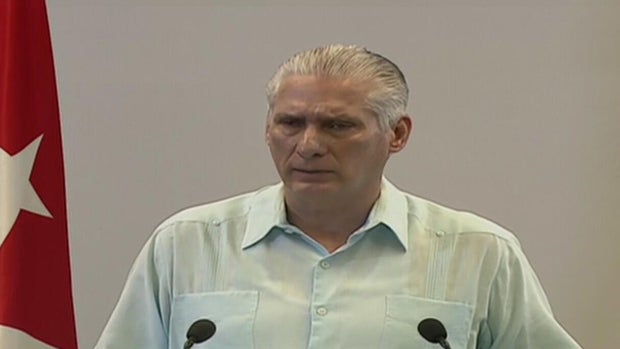
Diaz-Canel confirmed last week that Cuba was in talks with U.S. as crisis worsens
Diaz-Canel confirmed on March 13 that Cuban officials recently held conversations with the U.S. government aimed at addressing long-standing differences between the two countries, but warned that any potential agreement is still in the early stages.
“Cuban officials recently held conversations with officials from the U.S. government to look for solutions to the bilateral differences that exist,” Diaz-Canel said during a press conference Friday morning.
Diaz-Canel said negotiations between governments often take place quietly and require time to develop.
“These are processes that are carried out with great discretion. They are long processes, and there has to be willingness and channels for dialogue, and all of that takes time,” he said.
The announcement on Friday came one day after the Cuban government said it would release 51 prisoners from off the island.