They swim with paddle-like tails, climb trees using hooked claws and hunt on land. Nile monitor lizards, powerful carnivores that can grow longer than six feet, are spreading through South Florida, earning a reputation from wildlife officials as one of the most dangerous invasive reptiles in the state.
Data show sightings have grown significantly in recent years, particularly in the Florida Peninsula, where entire neighborhoods in Cape Coral are now considered their established habitat.
According to EDDMapS data, Lee County, in the Tampa Bay area, leads the state with 1,616 reported sightings, followed by Palm Beach County with 299, Miami-Dade with 76, and Broward with 68.
The Florida Fish and Wildlife Conservation Commission classified the Nile monitor as an invasive species and added it to Florida’s Prohibited species list in April 2021.
Where do Nile monitors come from? And how did they get to Florida?
The Nile monitor is a semi-aquatic lizard native to sub-Saharan Africa. It is the largest lizard species in Africa, and according to the U.S. Geological Survey, the largest and most dangerous non-native lizard established in the United States.
Adults can stretch more than 7.5 feet long and weigh over 20 pounds, according to USGS. FWC said a typical adult in Florida averages about 5 feet and roughly 15 pounds.
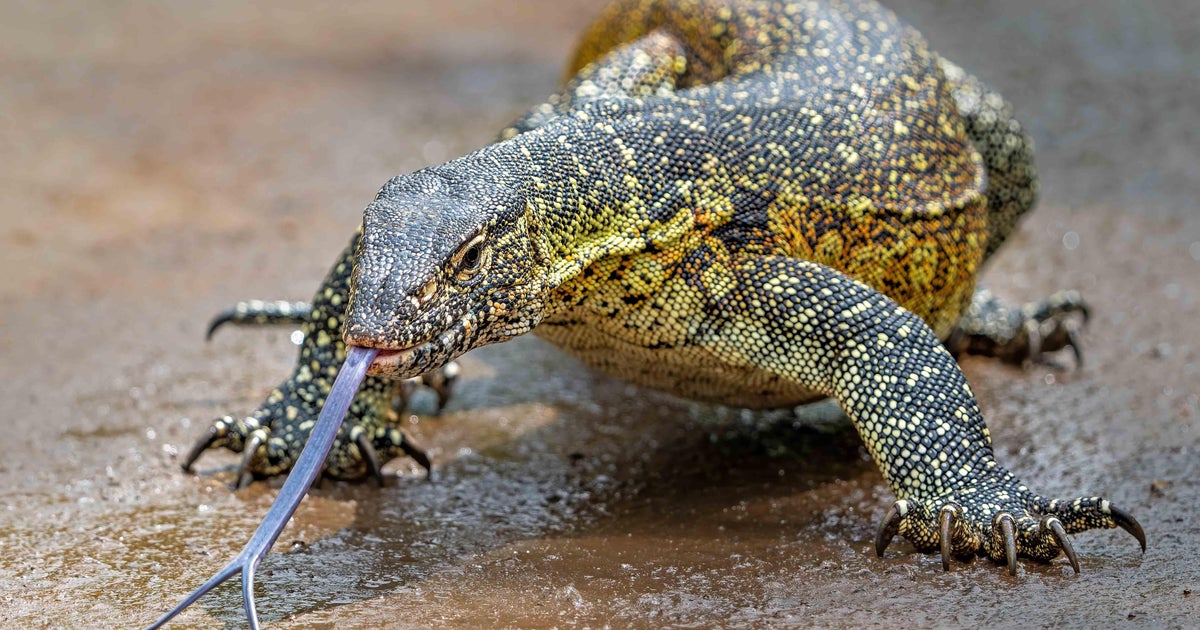
They’re olive green to black with yellow striping on the head and jaw. Their tails are long and flattened like a paddle, which experts say helps them swim. They can stay underwater for 12 to 15 minutes and are just as comfortable climbing trees as they are moving through canals.
USGS said they’re also smart, adaptable and highly mobile, traits that make invasive species especially difficult to control.
Henk Bogaard / Getty Images
In Africa, Nile monitors are found throughout much of the continent, especially near rivers, wetlands and lakes.
In Florida, wildlife officials believe most populations stem from the pet trade.
According to FWC and USGS, monitors likely arrived through escaped or intentionally released pets. They can break out of cages using their claws or push open enclosures. Some may have escaped during hurricanes that damaged reptile facilities. Others may have been released when they became too large or difficult to handle.
Once established near canals and waterways, they found ideal habitat. South Florida’s extensive canal system essentially acts like a highway network for a semi-aquatic reptile, experts say.
Why are Nile monitors considered dangerous?
Nile monitors are powerful wild predators that are generally not aggressive toward people unless cornered, wildlife experts said.
FWC described them as “generalist feeders,” meaning they eat almost anything they can overpower. That includes fish, frogs, turtles, snakes, birds and their eggs, small mammals and even young crocodiles.
Because they raid nests, they pose a risk to protected species such as sea turtles, gopher tortoises, burrowing owls and the American crocodile, according to FWC and USGS.
USGS noted their size and defensive behavior make them potentially dangerous to pets and, if cornered, to humans. They can bite with strong jaws, slash with sharp claws or whip their muscular tails.
FWC warned residents not to attempt to capture them.
Getty Images / Fotofeeling 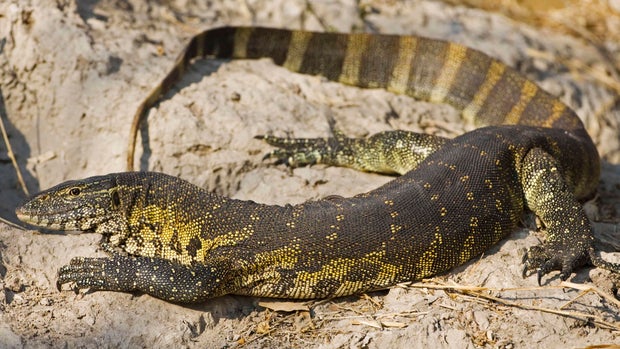
In Cape Coral, where the largest known population exists, residents have reported monitors digging burrows along canal banks and roaming residential streets.
“There are a lot of invasive monitors, especially in our neighborhood,” Cape Coral resident Jack Schwartz told local television station WZVN on Feb. 20.
Alane Passero described one running inside her home.
“[Out of the] corner of my eye, I see this huge monster running in my house straight to the back door. The nails are clacking on the floor. I’m screaming my head off,” she said.
Florida Nile monitors vs. green iguanas
South Florida residents are used to seeing green iguanas, especially after cold snaps. But Nile monitors are a different animal.
Green iguanas are mostly plant-eaters. Nile monitors are carnivores that actively hunt vertebrate prey.
Monitors are bulkier, with longer necks, narrower snouts and thicker, more muscular tails. They also have a blue tongue, a distinctive trait noted by USGS.
And while iguanas can grow large, no native or commonly seen lizard in Florida approaches the Nile monitor’s size and strength.
Where are Nile monitor sightings growing the most in Florida?
According to EDDMapS:
- Lee County: 1,616 sightings
- Palm Beach County: 299
- Miami-Dade: 76
- Broward: 68
USGS stated the species is firmly established in Lee County and spreading into Charlotte County. FWC confirmed established populations in Lee and Palm Beach counties, with additional reports across South Florida.
Recent confirmed sightings include:
- Cape Coral in Lee County, Aug. 7, 2025
- Boynton Beach in Palm Beach, Sept. 10, 2025
- Broward, Jan. 16, 2024
- Miami-Dade, Nov. 19, 2021
While some counties report isolated individuals, experts caution that single sightings should not automatically be dismissed as escaped pets.
Can Florida stop the spread of Nile monitor lizards?
Florida wildlife experts say full eradication is no longer considered feasible, according to USGS and researchers at the University of Florida.
FWC actively removes Nile monitors from known populations and encourages residents to report sightings through the IveGot1 app or by calling 888-483-4681.
The reptiles can be humanely killed on private property without a permit. The City of Cape Coral operates a local trapping program, and federal partners manage populations at Homestead Air Reserve Base.
For now, wildlife officials say early reporting is key.
And for South Florida residents, the message is simple: if you see what looks like a small dinosaur near your canal, don’t approach it — take a photo and call it in.