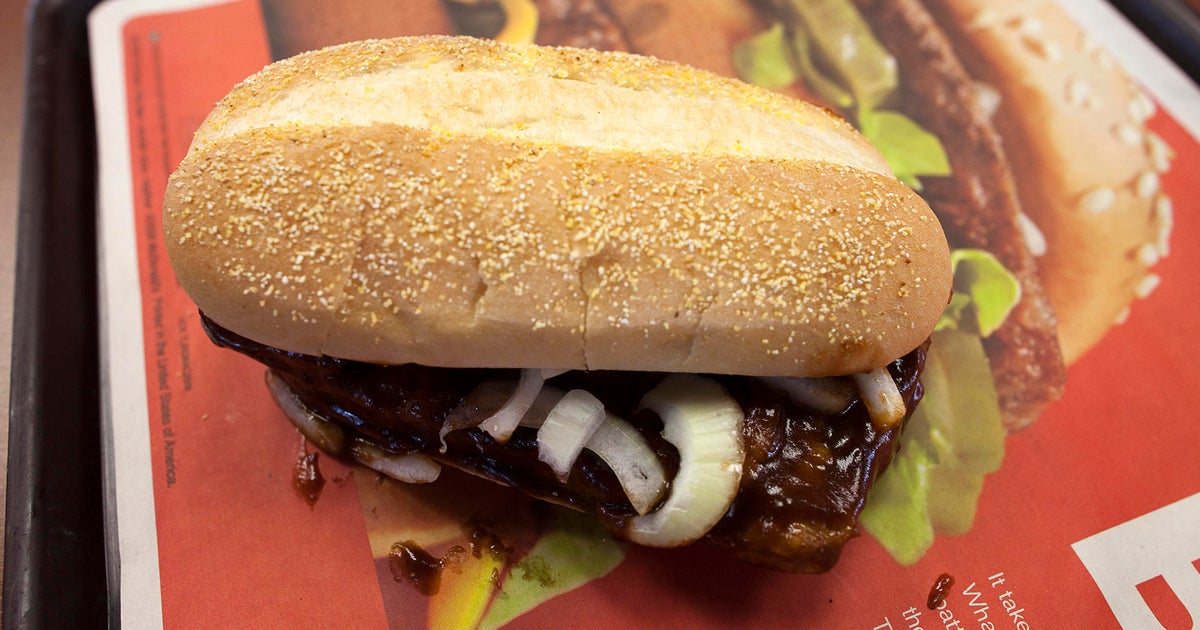
A lawsuit filed late last month took Chicago-based McDonald’s to task over the McRib sandwich, calling its name a form of false advertising.
The lawsuit was filed Dec. 23 in U.S. District Court in Chicago. Plaintiffs Peter Le of Baldwin Park, California; Charles Lynch of Poughkeepsie, New York; Dorien Baker of Chicago; and Darrick Wilson of Washington, D.C., sought class-action status in the lawsuit.
McDonald’s offers the McRib during limited windows with ad campaigns to announce their return each time, most recently starting this past November.
The lawsuit said McDonald’s has “cultivated a sense of anticipation around the McRib, leveraging its scarcity to drive sales across its many locations.”
As CBS News has reported before, the notorious 520-calorie sandwich contains just five simple ingredients: seasoned boneless pork dipped in BBQ sauce, sliced onions, and dill pickles in a toasted homestyle bun.
“When everything combines, you have BBQ pork sandwich perfection,” McDonald’s has said.
But the lawsuit alleged that fans of the sandwich assume they’re biting into pork rib meat, but the McRib does not really contain any.
Despite its name and distinctive shape — its meat patty has been deliberately crafted to resemble a rack of pork ribs—the McRib does not contain any actual pork rib meat at all,” the lawsuit said. “Instead, its meat patty is reconstructed using ground-up portions of lower-grade pork products such as, inter alia, pork shoulder, heart, tripe, and scalded stomach.”
The lawsuit said actual pork rib meat cuts — spareribs and baby back ribs — are premium cuts of pork that are more valuable than lower-quality cuts. Despite not containing any rib meat, the McRib is among the most expensive single-item options offered on the menu at McDonald’s, the lawsuit said.
“The name ‘McRib’ is a deliberate sleight of hand. By including the word “Rib” in the name of the sandwich, McDonald’s knowingly markets the sandwich in a way that deceives reasonable consumers, who reasonably (but mistakenly) believe that a product named the ‘McRib’ will include at least some meaningful quantity of actual pork rib meat, which commands a premium price on the market,” the lawsuit said. “McDonald’s does this despite knowing that the sandwich in fact does not contain any meaningful quantity of actual pork rib meat — indeed, none at all.”
The lawsuit said consumers are led to believe they’re eating rib meat when they’re eating a McRib, but are actually eating “a lower-quality restructured meat product that did not contain any actual pork rib meat.”
“Put simply: consumers have been materially misled en masse as a result of McDonald’s deceptive labeling and marketing into purchasing sandwiches that they would not otherwise have purchased, or would only have paid less for, had they known the truth,” the lawsuit said.
The lawsuit further alleged McDonald’s knows or should know that customers are being misled, given the name “McRib” and the way the sandwich’s patty is shaped to look like a pork rib.
The lawsuit accused McDonald’s of fraudulent omission or concealment, fraudulent misrepresentation, negligent misrepresentation, and other counts. It demanded an order “enjoining McDonald’s to desist from further deceptive naming, marketing and advertising practices with respect to the McRib and such other injunctive relief that the Court deems just and proper,” and an award of damages to the plaintiffs.
McDonald’s USA issued the following statement on the lawsuit:
“This lawsuit distorts the facts and many of the claims are inaccurate. Food quality and safety are at the heart of everything we do – that’s why we’re committed to using real, quality ingredients across our entire menu. Our fan-favorite McRib sandwich is made with 100% pork sourced from farmers and suppliers across the U.S. We’ve always been transparent about our ingredients so guests can make the right choice for them.”
McDonald’s added that it does not use pork hearts, tripe, or scalded stomach in the McRib patty, and such items are not allowed in any of its pork products. The company said the McRib has a base of 100% seasoned boneless pork.
McDonald’s first added the McRib to menus in Kansas City in 1981, according to CBS News Austin.
The chain pulled it from its menu four years later, but the sandwich has become a cult favorite among McDonald’s loyalists in recent years. It was previously sold regionally before expanding to all of its U.S. restaurants in 2020, CBS News Austin reported.