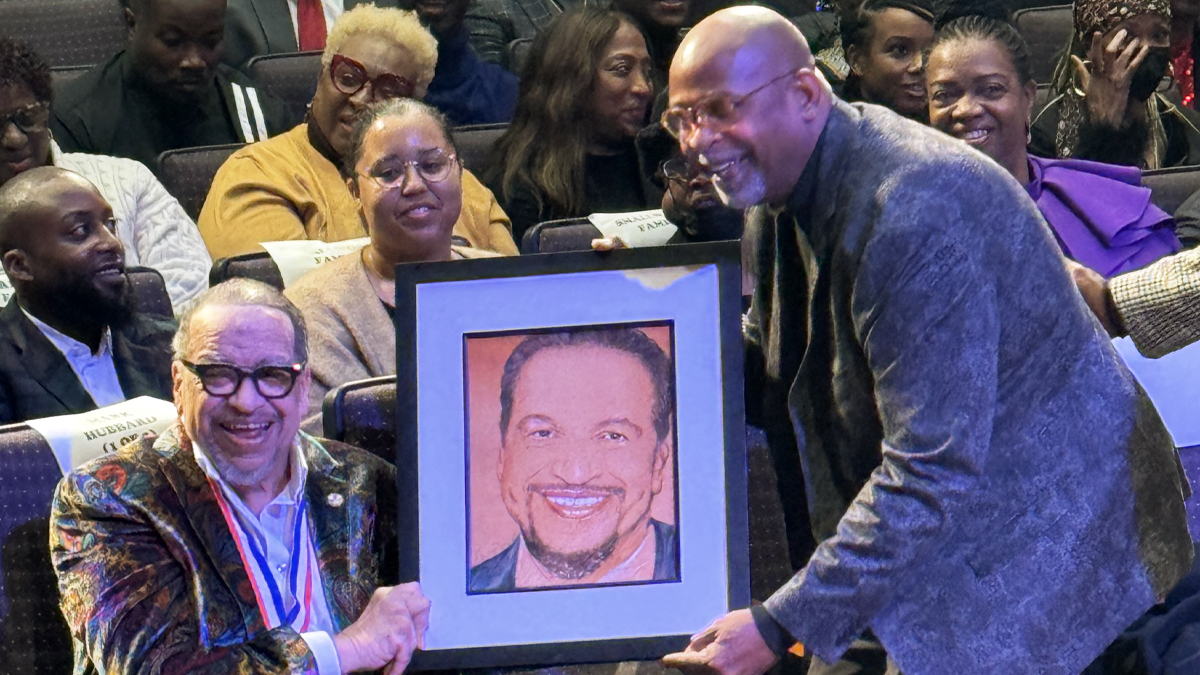
Richard Smallwood, a gospel singer and recording artist nominated eight times for Grammy Awards, has died. He was 77.
Smallwood died Tuesday of complications of kidney failure at a rehabilitation and nursing center in Sandy Spring, Maryland, representative Bill Carpenter announced.
Smallwood had health issues for many years, and music gave him the strength to endure, Carpenter said in an interview.
“Richard was so dedicated to music, and that was the thing that kept him alive all these years,” he said. “Making music that made people feel something is what made him want to keep breathing and keep moving and keep living.”
Often referred to as the maestro or composer, Smallwood was a musical and gospel icon. His love of finding the right pitch started at age 5, playing piano by ear before taking formal lessons. By 11, he had formed his own gospel group.
Raised in Southeast D.C., his appreciation for hymns was thanks largely to Union Temple Baptist Church, where his stepfather was the pastor.
“He really was a genius, a musical genius, a prodigy from a child up. “He was very, very very just giving. Just a great friend,” said gospel artist and songwriter Donald Lawrence.
Lawrence said he was inspired by Smallwood’s talent, blazing a trail for the next generation. Their shared devotion to praise and worship allowed them to develop a friendship.
“His art was blending the classical music with gospel which, that hadn’t happened before,” he said.
“He was definitely one of my musical heroes, and I was glad that I was able to get to know him,” he added.
Smallwood’s songs were performed and recorded over the years by artists such as Whitney Houston, Stevie Wonder, Destiny’s Child and Boyz II Men.
Smallwood “opened up my whole world of gospel music,” singer and songwriter Chaka Khan wrote on Facebook after his death.
“His music didn’t just inspire me, it transformed me,” she said. “He is my favorite pianist, and his brilliance, spirit, and devotion to the music have shaped generations, including my own journey.”
Smallwood was born Nov. 30, 1948, in Atlanta, according to biographic materials provided by Carpenter. He was primarily raised in Washington, D.C., by his mother, Mabel, and his stepfather, the Rev. Chester Lee “C.L.” Smallwood.
Smallwood was a music pioneer in multiple ways at Howard University in Washington, where he graduated cum laude with a music degree. He was a member of Howard’s first gospel group, the Celestials. He was also a founding member of the university’s gospel choir, according to an obituary from Carpenter.
Smallwood learned from the late Roberta Flack, a musical genius in her own right.
“A couple of my students went on to become successful. Richard Smallwood, who is a great gospel musician and very hugely successful in the gospel music world,” she told NBC Washington in 2003.
After college, Smallwood taught music at the University of Maryland and went on to form the Richard Smallwood Singers in 1977, bringing a contemporary sound to traditional gospel music. He later formed Vision, a large choir that fueled some of his biggest gospel hits, including “Total Praise.”
“Total Praise” became a modern-day hymn that touched people from all types of backgrounds and walks of life, Carpenter said by phone Wednesday.
“You can go into any kind of church — a Black church, a white church, a nondenominational church — and you might hear that song,” he said. “Somehow it found its footing throughout the whole Christian world. If he never wrote anything else, that would have put him in the modern hymn book.”
In recent years, mild dementia and other health issues prevented Smallwood from recording music, and members of his Vision choir helped care for him.
His legacy will live on “through every note and every soul he touched,” Khan said.
“I am truly looking forward to singing with you in heaven,” she said.
In recent years, Smallwood’s presence was embedded in his church, Metropolitan Baptist Church, where he served as the artist in residence.
“Blessed us in so many distinct ways by just sliding in on the piano, playing for our historic communion services, and also with our choir,” said Pastor George L. Parks Jr.
Parks said he believes Smallwood’s legacy and character will continue to be felt worldwide.
“Everyone’s maestro, everyone’s songwriter that ministered to their hearts, especially in times of great need and intentional worship,” he said.
Lawrence spoke about a lesson Smallwood taught him about music.
“Be OK with being who you are when it comes to your artform. You don’t have to be like anyone else to be popular, to get on the charts, to win awards,” he said.